A critical Linux KVM vulnerability allows virtual machines running on vulnerable AMD servers to read host memory, potentially exposing data belonging to other customers sharing the same physical infrastructure. Researchers demonstrated the flaw by extracting approximately 127 GB of memory from a DigitalOcean cloud server using a guest virtual machine they controlled.
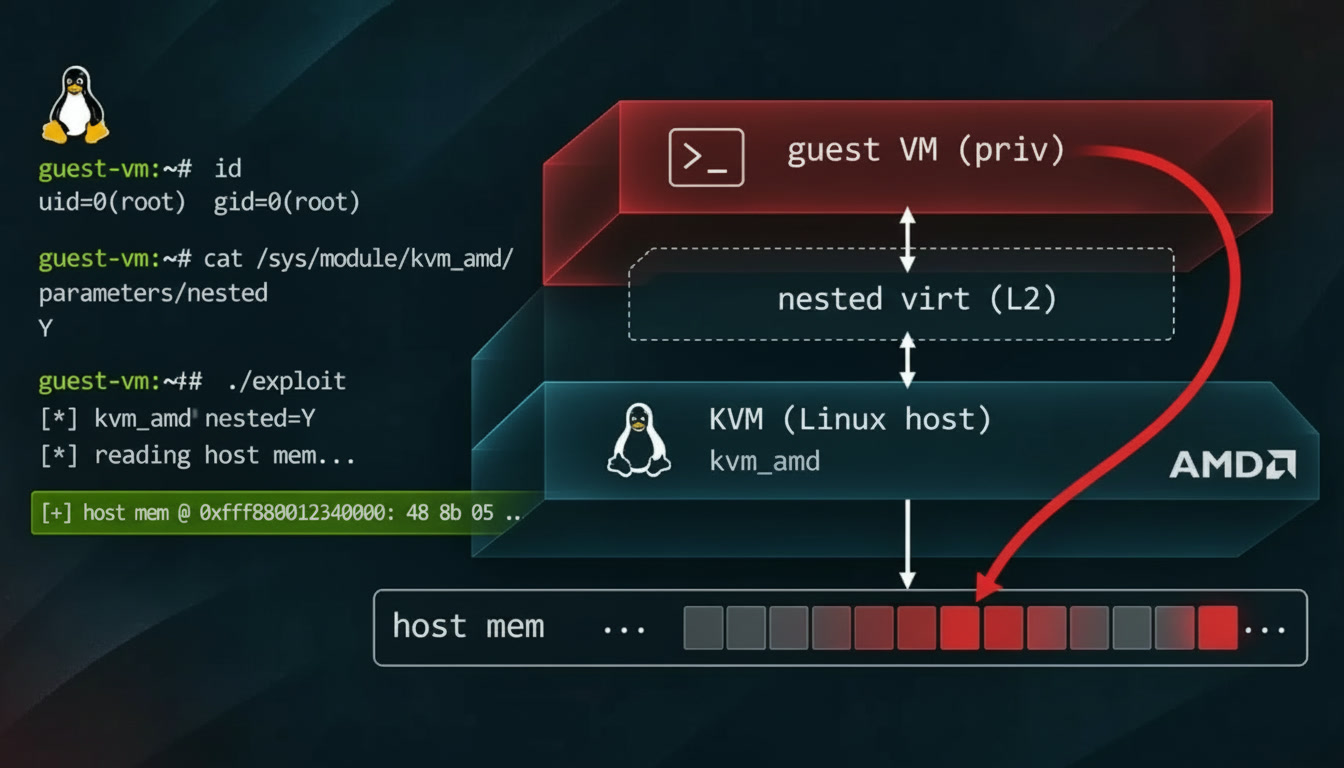
Tracked as CVE-2026-99312, the vulnerability affects KVM hosts running AMD processors with nested virtualization enabled. It requires an attacker to already control a virtual machine on the vulnerable host, rather than simply having network access.
DigitalOcean confirmed the exploit worked against its infrastructure and classified the issue as critical for its shared cloud environment. The provider deployed a live patch across its fleet and told Droplet customers: “No action needed on your part.”
How the KVM vulnerability exposes host memory
Oren Yomtov, a researcher at Terra Security, discovered the flaw and reported it through DigitalOcean’s bug bounty program.
According to the provider’s disclosure post, a test against one of its Droplets returned the host’s kernel version followed by approximately 127 GB of host RAM, mapped as read-only.
Researchers also demonstrated write access on their own bare-metal AMD server. A guest virtual machine successfully modified 32 selected bytes in an active host kernel memory page, with a kernel module confirming the change.
Terra Security’s technical analysis traces the problem to a stale pointer in KVM’s nested virtualization memory-management process.
When an INIT reset stops a nested virtual machine, KVM fails to restore the outer VM’s page-table pointer. The pointer consequently references memory that the kernel has already freed.
After that memory is reused, a guest can manipulate its contents and create entries that the processor interprets as legitimate memory translations. This can expose physical memory belonging to the host.
The flaw originated from a 2022 security patch addressing CVE-2022-3344, which missed resetting the relevant page-table pointer.
Affected kernels and available mitigations
The Linux kernel’s CVE team assigns CVE-2026-99312 a severity score of 8.8, while Red Hat’s preliminary assessment rates it Moderate at 5.6. The different assessments reflect disagreements over the potential impact.
The upstream fix arrived in kernel versions 7.3.5, 6.18.64 and 6.12.118. It resets the affected memory-management state during every INIT operation.
Distribution support remains incomplete. Debian lists its released kernels as vulnerable, with a fix available in unstable. Ubuntu also lists affected kernels without a fixed package released. Red Hat identifies Enterprise Linux 9 and 10 kernels as affected, with fixes deferred, while Enterprise Linux 8 is not affected.
Until patched host kernels are installed and servers rebooted, administrators can disable nested virtualization. VirtFusion’s operator guide notes that this feature is enabled by default in the AMD KVM module.
Administrators should check the setting using:
cat /sys/module/kvm_amd/parameters/nestedA value of 1 or Y indicates that nested virtualization is enabled. If updates are unavailable, administrators can configure:
options kvm_amd nested=0After rebooting, verify the running kernel with `uname -r` and check the nested virtualization setting again.
Cloud operators should prioritise host-level updates and review nested virtualization configurations. Updating guest operating systems alone does not address this vulnerability.