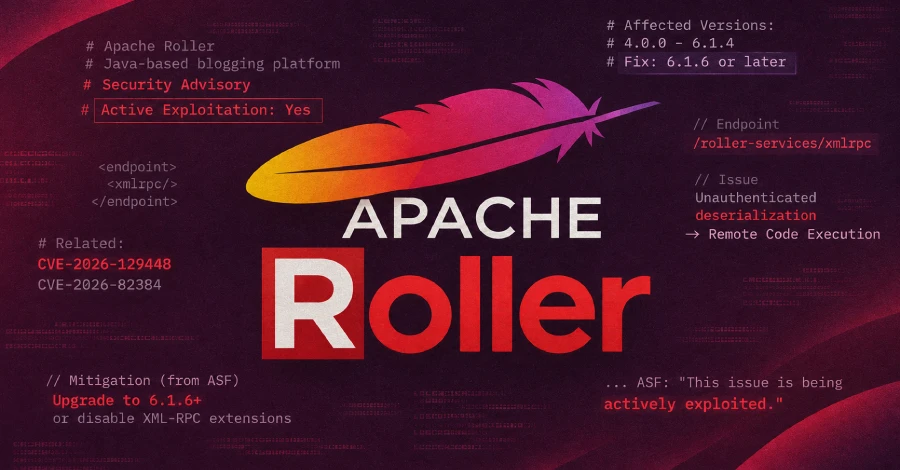
The Apache Roller vulnerability CVE-2026-129448 is being actively exploited, allowing unauthenticated attackers to execute arbitrary code on vulnerable servers. The Apache Software Foundation (ASF) has confirmed attacks targeting the critical deserialization flaw, which carries a CVSS score of 9.8.
The vulnerability affects Apache Roller versions 4.0.0 through 6.1.4. The open-source Java blogging platform processes attacker-controlled data through its XML-RPC endpoint before checking whether the requester is authenticated, creating an opportunity for remote code execution without valid credentials.
XML-RPC endpoint exposes unauthenticated servers
According to the security notice published on the Apache mailing list, the vulnerability stems from how the XML-RPC endpoint handles vendor extension types.
The notice states:
“Deserialization of Untrusted Data in Apache Roller versions 4.0.0 through 6.1.4 allows an unauthenticated remote attacker to execute arbitrary code. The XML-RPC endpoint accepts vendor extension types and deserializes them before authenticating the requester.”
Because deserialization happens before authentication, attackers can reach the vulnerable processing functionality without first supplying valid login credentials.
The Apache project has also confirmed that the issue is related to an earlier vulnerability tracked as CVE-2026-82384. That advisory, published in September 2026, identified only Apache Roller 6.1.5 as affected.
“This is the same vulnerability as CVE-2026-82384, which listed only Apache Roller 6.1.5 as affected.”
The updated security notice expands the affected version range to include releases from 4.0.0 through 6.1.4.
The project explicitly acknowledged ongoing attacks in its notice:
“This issue is being actively exploited.”
However, the advisory does not identify the attackers, targeted organizations or technical details of the exploitation attempts.
Apache releases patched version and mitigation options
The ASF recommends upgrading to Apache Roller 6.1.6 or later. The updated release disables vendor extension types and rejects XML-RPC requests when the XML-RPC feature is disabled.
Administrators unable to upgrade immediately can apply either of two workarounds:
- Set enabledForExtensions to false in WEB-INF/web.xml.
- Remove the /roller-services/xmlrpc servlet mapping.
Both changes require restarting Apache Roller to take effect.
The project also warns against relying exclusively on the administration interface to disable XML-RPC.
“Disabling XML-RPC in the administration UI is not enough, because older versions deserialize the request before checking that setting.”
Security researcher n0mi1k is credited with discovering the vulnerability, while Matt Raible reported it to the Apache project.
Administrators urged to check affected installations
The confirmed exploitation makes identifying vulnerable deployments a priority for organizations running Apache Roller.
Administrators should inventory their installations, establish whether they are running affected releases and determine whether the XML-RPC endpoint is accessible.
Internet-facing servers warrant particular attention, although internal deployments should also be reviewed.
Organizations should upgrade to Apache Roller 6.1.6 or later. Where immediate upgrades are not possible, they should implement one of the Apache-recommended workarounds and restart the application.