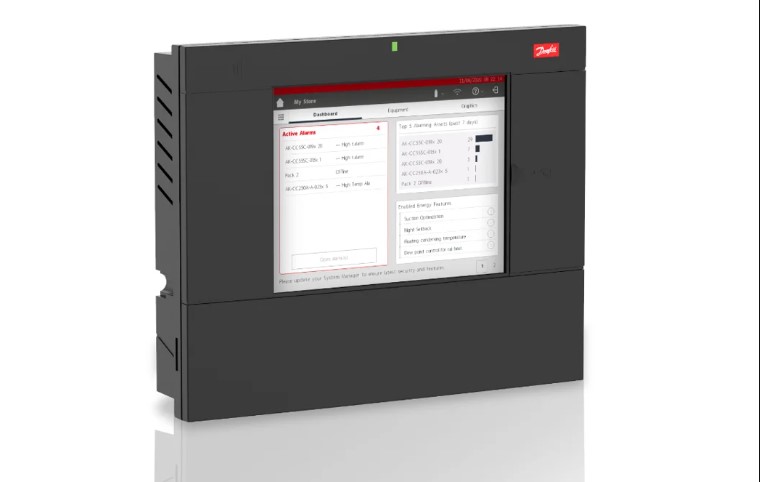
Six zero-day vulnerabilities in Danfoss AK-SM800A refrigeration controllers could allow attackers to execute remote code and take control of affected systems, according to cybersecurity researchers at Midnight Blue.
Researcher Carlo Meijer discovered the flaws in less than an hour while manually examining publicly available firmware. All versions up to and including 5.3.2 are affected, with no CVE identifiers assigned as coordinated disclosure with Danfoss continues.
The findings raise additional concerns as internet-connected refrigeration controllers from Danfoss and other manufacturers have been targeted in attacks across Europe since October 11. Those earlier incidents involved disrupted defrost cycles, spoiled food and fires, although researchers have not linked them to the newly discovered vulnerabilities.
Five vulnerabilities allow unauthenticated remote access
According to Midnight Blue’s analysis, all six vulnerabilities are stack-based buffer overflows. Five affect web request handlers within sm_app, the controller’s main application, which operates without requiring authentication.
The application contains hundreds of unchecked strcpy calls and lacks stack canaries and Position Independent Executable (PIE) protections.
Midnight Blue explained the exploitation risks: “Of course, remotely triggering a crash is bad in itself, but being able to leverage the buffer overflow to obtain remote code execution is much worse. Any reasonably experienced exploit developer will agree exploiting straightforward stack-based buffer overflows on ARM Linux without exploit mitigations is very straightforward. And if they don’t, there’s probably a frontier or open weight model out there willing to help them agree.”
The sixth vulnerability affects sm_fcgi_app, the component responsible for enforcing Danfoss’s Strict mode security protections.
Strict mode, enabled by default since version 4.0, requires HTTPS connections and session tokens to restrict unauthenticated access. However, researchers demonstrated that the sixth flaw could crash the gateway even with this protection enabled, potentially allowing remote code execution with further exploitation work.
Attackers could disrupt refrigeration systems
Successful exploitation could give attackers root-level access to affected controllers because the main application already runs with elevated privileges.
This could allow them to modify temperature settings, manipulate defrost schedules, conceal malicious activity from logs or install malware capable of surviving factory resets and firmware updates.
The absence of secure boot also creates additional risks. Attackers could erase the controller’s flash memory, potentially rendering the device unusable until it is replaced.
Such disruptions could leave refrigeration equipment unavailable for days, affecting businesses dependent on continuous cooling.
No patch available as researchers urge restricted access
Danfoss has not released a confirmed fix for the six vulnerabilities. Midnight Blue also reported that firmware version 5.4.0 does not resolve the flaws.
Germany’s BSI initially indicated that version 5.4.0 was unaffected but later corrected its assessment, saying it could not rule out exposure.
The BSI has not identified confirmed exploitation of these six vulnerabilities in the wild. Researchers have also not established a connection between the flaws and the refrigeration attacks reported since October.
Midnight Blue recommends removing controller management interfaces from direct internet exposure. According to CERT-FR recommendations cited in the report, administrators should restrict access through VPNs, private APNs or tightly controlled firewall-enforced IP allowlists.
Organizations should inventory internet-accessible controllers, including devices connected through system integrators’ 4G modems. Administrators should also inspect temperature settings, defrost schedules, alarms, user accounts and remote access configurations for unauthorized changes.
Until a vendor fix becomes available, operators should restrict remote management access, review controller configurations and change passwords if compromise is suspected.