Security researcher Chaotic Eclipse has released FastUnlock, a Windows zero-day vulnerability that reportedly bypasses the lock screen and enables code execution on fully encrypted systems protected by BitLocker.
The vulnerability abuses Microsoft’s Narrator accessibility feature to access functionality normally unavailable before authentication. According to the researcher’s GitHub advisory, the exploit worked against a fully encrypted Windows 11 26H2 machine with the November security updates installed.
Chaotic Eclipse claims the attack took just five minutes to compromise the tested system, raising concerns about the security of encrypted Windows devices against attackers with physical access.
Narrator provides a path around the lock screen
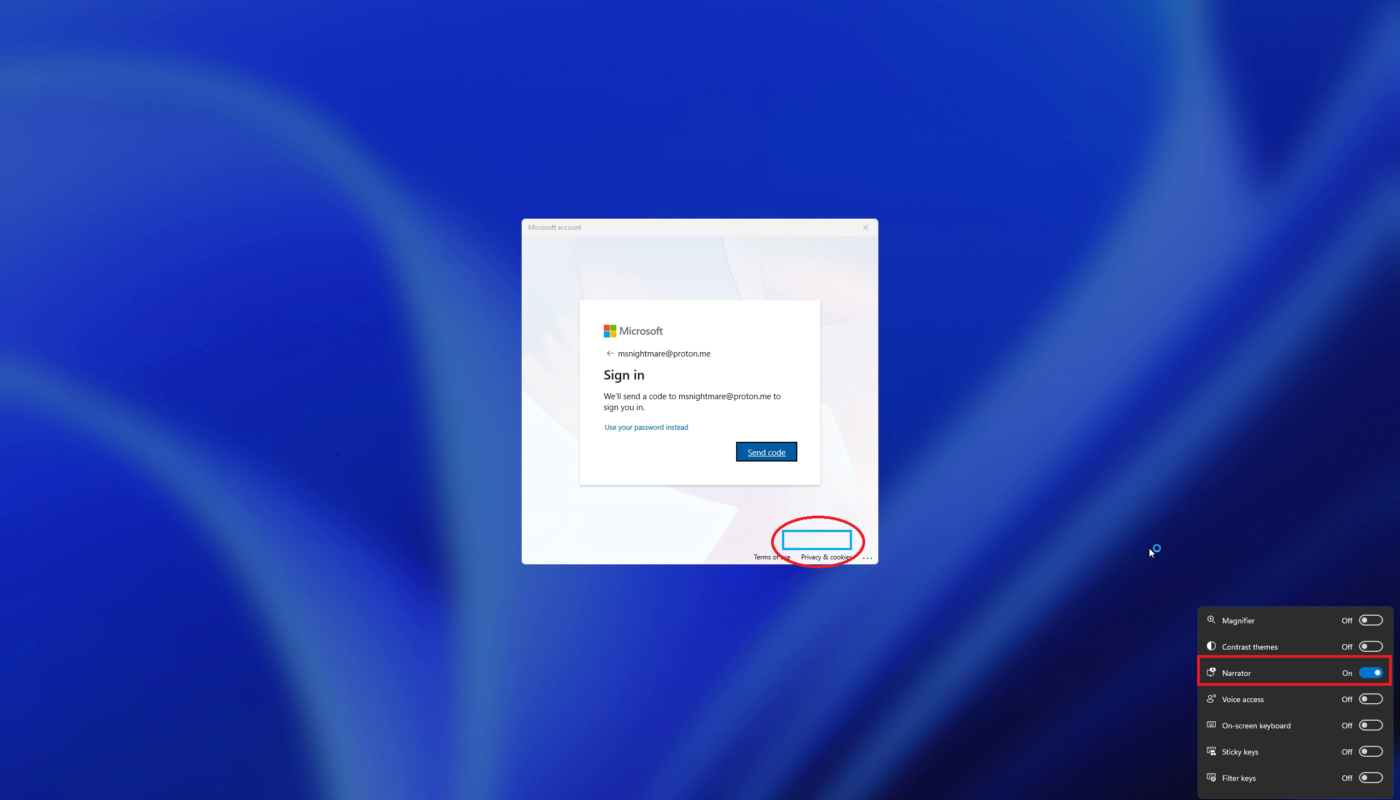
The attack requires physical access to the target computer and at least one user account associated with an online account. It can reportedly be initiated through the “I forgot my PIN” or password recovery option on the Windows lock screen.
From the Microsoft account recovery interface, an attacker enables Narrator, Microsoft’s built-in screen-reading tool. The researcher says the redesigned interface allows Narrator to interact with a hidden background window operating in the lock screen account context.
Using keyboard combinations, an attacker can navigate Narrator’s interface and access its settings. The researcher describes several possible routes to code execution, including opening File Explorer through the Bluetooth and Devices and AutoPlay settings.
The resulting execution reportedly occurs under WsiAccount, potentially allowing an attacker to run a binary from a connected USB storage device without completing normal authentication.
Windows 11 26H2 is the tested version
In the advisory, Chaotic Eclipse describes the exploit’s reported reliability across the machines tested:
“It took a total of 5 minutes from finding this to breaching a fully encrypted bitlocker machine with Windows 11 26H2 November Patch installed, an issue caused by total negligence from Microsoft’s side… The vulnerability seems to be extremely consistent in every machine I tested it in, in other words, if you know how to control narrator in the background properly or just press the correct combination of buttons, you will get code execution in the target machine as well.”
However, the researcher has not established whether other Windows releases are affected.
“I have not checked other windows versions so I am not really sure if this might work on windows 10.”
The published report also describes the USB-based execution method but does not include a complete demonstration of that stage.
Researcher’s history of Windows zero-day releases
Chaotic Eclipse, also known as INFINITE NIGHTMARE, MSNightmare and Nightmare-Eclipse, has previously published proof-of-concept exploits targeting Microsoft products and other security software.
Among the researcher’s earlier releases are Undefend and RedSun, which targeted Microsoft Defender. More recent publications include BigDiskBuster, targeting Windows Defender Update, alongside GreenSection for Nvidia and ShieldCrash for Microsoft Defender.
Other disclosed vulnerabilities have targeted Kaspersky Endpoint Security, Avast Antivirus and CrowdStrike Falcon.
SecurityWeek previously reported that Chaotic Eclipse had identified himself as Abdelhamid Naceri, a security researcher who previously worked for Microsoft in the UK and Germany.
Microsoft has not provided a response or mitigation guidance in the supplied report.
Organizations should monitor Microsoft’s security advisories for confirmation, restrict physical access to unattended computers and review device security procedures. Administrators should not assume BitLocker alone prevents attacks involving physical access to an exposed device.