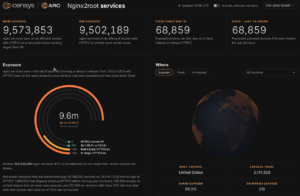
Palo Alto Networks has confirmed that two critical NGINX HTTP/2 vulnerabilities could enable remote code execution or crash worker processes on affected PAN-OS and Panorama deployments.
The vulnerabilities, tracked as CVE-2026-123633 and CVE-2026-123007, affect systems with HTTP/2 enabled. Palo Alto Networks assigns the issues a CVSS v4.0 score of 9.2 and classifies its response urgency as moderate.
According to the company’s security advisory, affected products include PAN-OS deployments, Panorama virtual appliances and M-Series appliances. Systems without HTTP/2 enabled are not affected.
The vendor also states that it has no knowledge of malicious exploitation of these vulnerabilities.
Two NGINX flaws create remote code execution risks
CVE-2026-123633 is a use-after-free vulnerability involving NGINX’s HTTP/2 proxy handling.
The problem occurs when active connections remain marked as reusable even though they should no longer be available. When a worker runs out of connection slots, NGINX can close connections and release their associated memory while continuing to send requests to backend servers.
This creates a memory management error that can crash the affected worker or potentially allow attackers to execute code.
However, the underlying vulnerability’s CVE record identifies an important exploitation condition: code execution requires Address Space Layout Randomization (ASLR) to be disabled or bypassed. ASLR makes memory addresses harder for attackers to predict.
The second flaw, CVE-2026-123007, involves HTTP/2 flow control. An integer underflow can cause the connection’s flow-control window to exceed its permitted limit.
Attackers can exploit this condition using specially crafted traffic to trigger a heap-based buffer overflow, potentially resulting in a worker crash or arbitrary code execution.
Palo Alto Networks releases fixed PAN-OS versions
Palo Alto Networks has provided product-specific upgrade guidance rather than relying solely on upstream NGINX version information.
The recommended fixes depend on the installed PAN-OS maintenance branch:
- PAN-OS 12.2: Upgrade to 12.2.4-h3 or later.
- PAN-OS 12.1.8 through 12.1.10: Install 12.1.10-h6 or later.
- PAN-OS 12.1.5 through 12.1.7: Install 12.1.7-h15 or 12.1.10-h6, subject to release availability.
- PAN-OS 11.2: Use 11.2.10-h19, 11.2.13-h6 or 11.2.16-h3, depending on the maintenance branch.
The vendor’s advisory lists November 23 as the expected release date for 12.1.7-h15, 11.2.10-h19 and 11.2.13-h6. Administrators should confirm that the required updates are available before planning upgrades.
PAN-OS 12.1 versions earlier than 12.1.5 and PAN-OS 11.2 versions earlier than 11.2.8 are listed as unaffected. Other reviewed on-premises products not identified in the advisory are also considered unaffected.
Disabling HTTP/2 provides temporary mitigation
Organizations unable to install the security updates immediately can disable HTTP/2 on PAN-OS and Panorama using Palo Alto Networks’ configuration guidance.
The vendor’s documentation explains that HTTP/1.1 is enabled by default, while HTTP/2 requires manual configuration.
Palo Alto Networks is handling remediation for its affected SaaS products, meaning customers do not need to take action for those services.
Administrators should check their PAN-OS versions, verify whether HTTP/2 is enabled and determine whether their Panorama appliances are affected. Where HTTP/2 is active, apply the appropriate fixed release or disable the protocol until patching is possible.