Xint Research has disclosed five critical vulnerabilities in NGINX and a separate Linux kernel flaw that attackers can chain to gain root access on affected systems.
The most severe issue, tracked as CVE-2026-123007, is an unauthenticated remote code execution vulnerability affecting NGINX configurations that use HTTP/2. The researchers demonstrated how an attacker could exploit the flaw to corrupt memory in an NGINX worker and execute commands without authentication.
The discovery, named NGINX2Root, also highlights how AI-assisted security research can uncover vulnerabilities in widely audited software.
CVE-2026-123007 enables unauthenticated code execution
The vulnerability affects NGINX Open Source and NGINX Plus configurations using HTTP/2. It stems from a flaw in HTTP/2 flow control that can cause a heap buffer overflow when NGINX processes specially crafted traffic.
The NGINX security advisory describes the issue:
“This issue affects NGINX Plus or NGINX Open Source configurations that use HTTP/2. When NGINX processes undisclosed traffic, the flow control window can exceed the allowed threshold, potentially resulting in a heap buffer overflow typically followed by an NGINX worker segmentation fault. Additionally, attackers can execute code on systems with Address Space Layout Randomization (ASLR) disabled or when the attacker can bypass ASLR. (CVE-2026-123007)”
The advisory also warns:
“An attacker could leverage this vulnerability to crash the NGINX worker process, corrupt its memory, or potentially execute code remotely. There is no control plane exposure; this is a data plane issue only.”
Xint researchers explained the exploitation process:
“Specifically, the most severe vulnerability is in nginx HTTP/2 flow control. An unauthenticated remote attacker can corrupt memory in an nginx worker, leak memory addresses, and overwrite the pointer to a cleanup function that runs when a connection closes.”
They added:
“This can be used to execute commands with worker privileges and receive the output over an existing connection.”
The affected NGINX versions range from 1.9.5 through 1.31.8, with the flaw fixed in version 1.31.9. NGINX Plus is also affected across several release lines.
Researchers used AI to uncover the flaws
The discovery is notable because NGINX has undergone extensive security testing over many years. Xint described the challenge of finding a pre-authentication remote code execution vulnerability in such widely deployed software:
“nginx runs roughly a third of the web and has been fuzzed and audited by the best researchers in the world for two decades. Pre-auth RCE in nginx almost never happens. The best known one is from 2013. This year every AI lab pointed models at it. Everyone figured the easy bugs were long gone.”
The researchers said the discovery began when a Xint researcher selected approximately 50,000 lines of NGINX code for analysis using a new capability developed ahead of ZeroDay Cloud.
“While testing a new Xint capability ahead of ZeroDay Cloud, a Xint researcher pointed it at a slice of nginx, about 50,000 lines. He picked the target; Xint did the rest. Ninety minutes later it flagged high severity issues with reproduction steps specific enough to become a working exploit in under ten minutes.”
Xint subsequently expanded the testing process and identified four additional critical NGINX vulnerabilities without further human guidance. One of those vulnerabilities was independently discovered by other researchers.
All five NGINX vulnerabilities received a CVSS 4.0 severity score of 9.2 out of 10.
The additional flaws affect specific configurations involving backend connection limits, proxy server names built using variables and certain directives, HTTP/3, and the NGINX mail proxy.
Linux kernel flaw makes root access possible
Although CVE-2026-123007 allows attackers to execute commands with NGINX worker privileges, Xint demonstrated that combining it with a separate vulnerability in the Linux kernel’s SCTP code could provide root access.
The researchers tested the attack chain in AWS, Google Cloud Platform, and Microsoft Azure environments, including systems reachable through public IP addresses. Luxembourg’s cybersecurity response team CIRCL confirmed that the kernel vulnerability was required to reach root privileges.
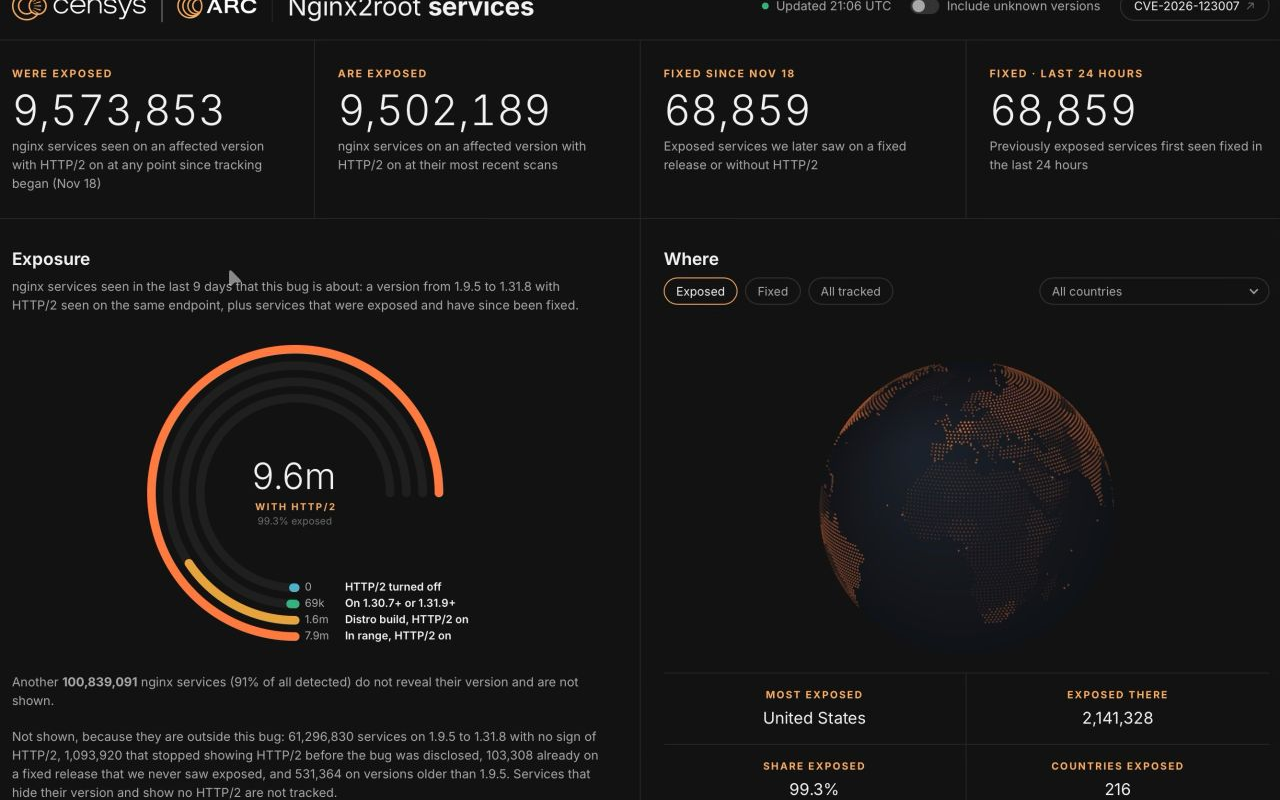
The scale of potential exposure is significant. According to Zakir Durumeric, Co-Founder and CEO of Censys, nearly 10 million internet services run NGINX versions vulnerable to the NGINX2Root CVEs.
A Shodan scan conducted on November 10 found that 98.9% of NGINX servers with a known version were running vulnerable releases. Xint also found that 88.6% of Fortune 500 companies use NGINX.
These figures do not mean every identified server can be exploited. HTTP/2 may be disabled, and some software distributors may have backported security fixes without changing the displayed NGINX version.
NGINX released fixes in versions 1.31.9 and 1.30.7. NGINX Plus users should update to 37.3.0.1 or 37.0.8.1, depending on their release line.
Administrators can check whether HTTP/2 is enabled by testing the server with OpenSSL:
`openssl s_client -connect example.com:443 -alpn h2`
A response showing `ALPN protocol: h2` indicates that HTTP/2 is enabled. Systems behind a CDN should be tested directly at the origin server because the CDN’s HTTP/2 connection to visitors does not necessarily mean the origin accepts HTTP/2.
Organizations should install the relevant vendor security updates and fully restart NGINX. A reload alone may leave the old binary running. If patching is not immediately possible, disabling HTTP/2 on affected listeners can mitigate CVE-2026-123007 and one other vulnerability, but it does not address the remaining three flaws.
No active exploitation has been reported, and CVE-2026-123007 was not listed in CISA’s Known Exploited Vulnerabilities catalog at the time of publication.