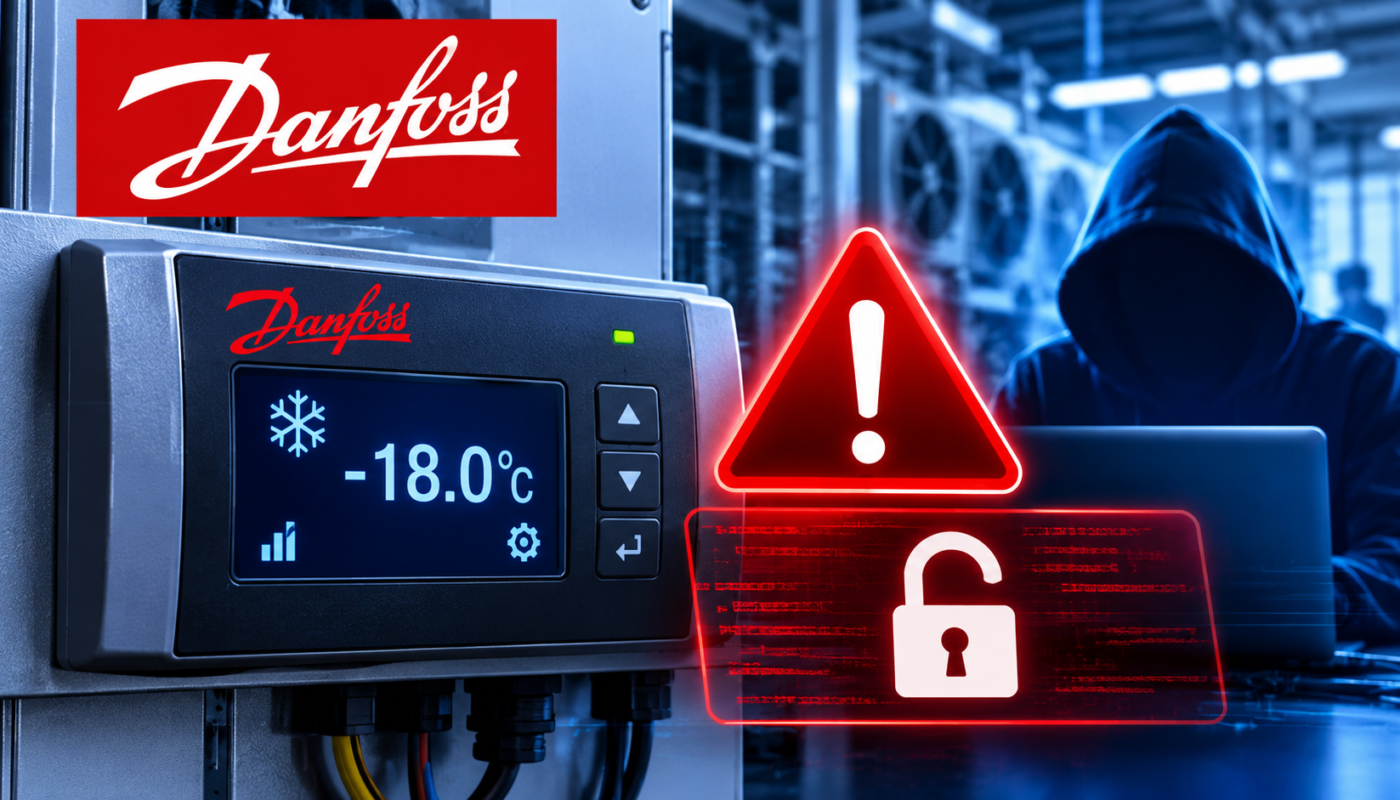
A critical vulnerability in Danfoss AK-SM 800A Series refrigeration controllers could allow unauthenticated attackers to execute arbitrary code remotely, putting internet-accessible industrial control systems at risk. Tracked as CVE-2026-129713, the flaw affects software version 5.4.0 and earlier.
The vulnerability was disclosed in a November 24, 2026, industrial control systems advisory from the U.S. Cybersecurity and Infrastructure Security Agency (CISA). The agency reported that it had no knowledge of public exploitation at the time of disclosure.
The affected controllers are used by food retailers to monitor and manage refrigeration systems. CISA identifies the equipment as deployed worldwide within the commercial facilities sector.
Stack-based buffer overflow exposes controller web server
CVE-2026-129713 is a stack-based buffer overflow affecting a Common Gateway Interface (CGI) handler responsible for processing web requests.
An attacker can potentially trigger the vulnerability by sending a specially crafted request that causes the handler to write beyond its allocated memory buffer. This can corrupt adjacent memory and potentially cause the web server to restart.
According to Danfoss, successful exploitation could result in arbitrary code execution with the privileges of the web server.
However, the available advisory information does not establish that attackers could obtain complete control of the affected controller or directly disrupt refrigeration operations.
CISA assigned the vulnerability a CVSS 3.1 score of 9.8 and a CVSS 4.0 score of 9.3, placing it in the critical severity category under both scoring systems.
The vulnerability requires neither authentication nor user interaction, making remotely accessible management interfaces particularly concerning.
CISA credited Carlo Meijer of Midnight Blue with discovering and reporting the vulnerability.
The broader exposure of industrial systems is also a concern. A separate analysis identified more than 6,300 internet-exposed industrial and building automation devices near U.S. data centers. This figure does not represent vulnerable Danfoss controllers but illustrates the risks associated with publicly accessible management interfaces.
Danfoss plans software fix and recommends Strict Mode
Danfoss said it will address CVE-2026-129713 in software version 5.5.x. The company also plans to remove the option to disable Strict Mode in a future release.
Until the security update becomes available, Danfoss recommends enabling Strict Mode, maintaining strong and unique passwords, and ensuring controllers are not assigned public IP addresses.
Strict Mode requires HTTPS connections, meaning organisations using certain third-party integrations may need to adjust their configurations to maintain compatibility.
Strong passwords can help protect user accounts, but they do not eliminate the underlying vulnerability because exploitation does not require authentication.
CISA recommends isolating industrial control systems
CISA recommends placing industrial control systems behind firewalls and separating them from business networks. Organisations that require remote access should use an updated virtual private network (VPN) or another protected connection.
These measures are particularly important for facilities operating refrigeration infrastructure across multiple locations.
Administrators should identify all deployed AK-SM 800A controllers, verify their installed software versions and determine whether their web interfaces are accessible from the internet or internal business networks.
Facilities teams should also assess the operational impact of enabling Strict Mode before making configuration changes, particularly where third-party monitoring and servicing integrations are involved.
Once Danfoss releases version 5.5.x, operators should install the update, verify that the vulnerability is addressed and confirm that authorised monitoring and remote access functions continue working.